Build journal3 min read
I stopped using language as an excuse
By Cédric · Published · This entry recounts 31 October 2026.
Before trying to help other creators cross a language barrier, I had one of my own to get past: pressing record.
The extra reason to put it off
Speaking to a camera already felt uncomfortable. I was also telling myself I should do it in English. The people I wanted to reach weren't necessarily French, so French seemed like a compromise before I'd even made a video.
But English is less natural for me. I have to think about the words as well as what I'm trying to say. That gave me another reason to delay. On 31 October, I decided to record the story in French and use our own experiment to answer the question: could the message travel without my having to perform it again?
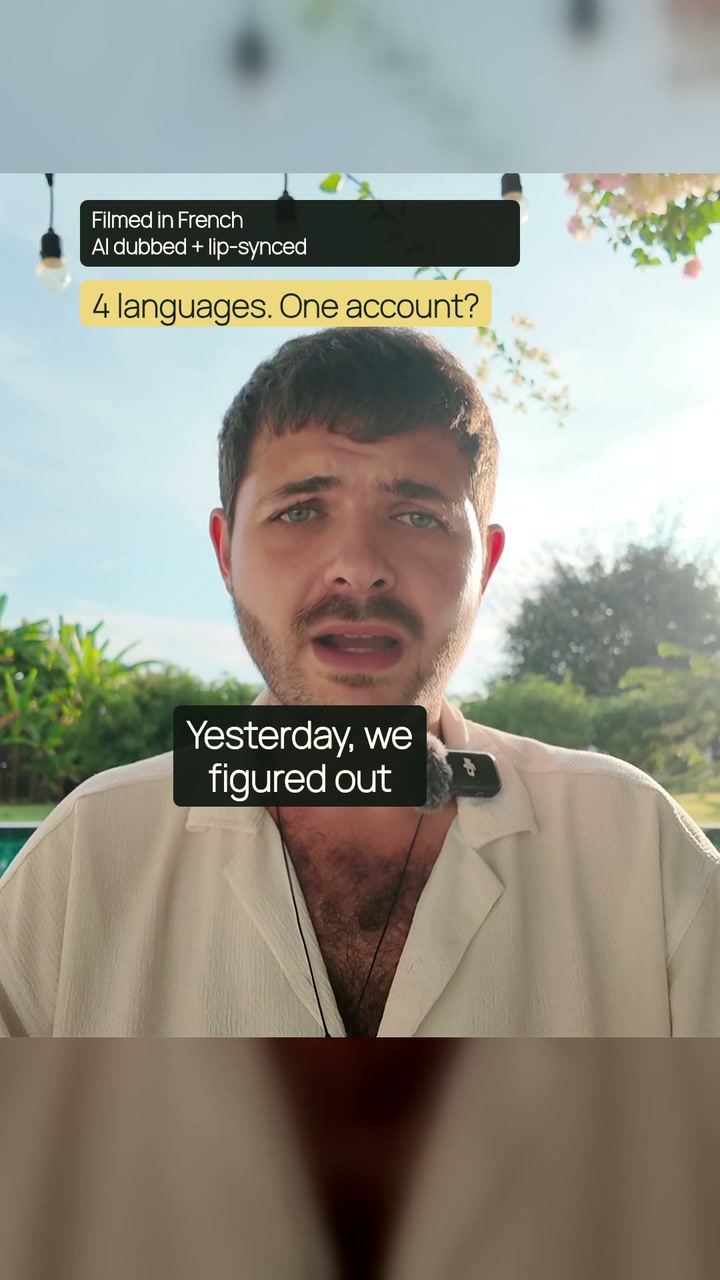
Recorded in French. AI-dubbed and lip-synced into the selected language.
Same translated audio in both versions.
Download subtitlesFirst, make something we can actually judge
We started with a short French pitch about making online training understandable in other languages. We created English, Spanish, Italian, Mandarin Chinese and German versions alongside the French original. The point was to have something to listen to, rather than another explanation of what AI might eventually do.
Those first translated clips tested the voice, wording and subtitles. The face still made its original French movements. Hearing another language over the same images made the idea tangible, but it also made the next question obvious: what happens when you look closely at the mouth?
So we tested English lip sync. The comparison uses the same English audio before and after, with the original mouth movements on one side and the adapted movements on the other. That keeps the comparison focused: you can watch what the image changes without a different performance distracting you.
The edit needed a story, too
A good demonstration still needs context. The longer video begins with why I was hesitating, explains why recording in French helps, then asks: that's the theory, but what does it look like in practice? Only then does the real English example appear.
It comes back to me in French for the invitation to follow what my cofounder and I are building. We removed an ending that felt too abrupt and a brand overlay the story hadn't earned. I wanted the video to feel like a person sharing an experiment, with a beginning and an ending you could follow.
That personal story is now available in English, French, Spanish and German. French is the original performance and includes an English demonstration. The other editions use AI dubbing and lip sync. They're there to inspect, including references that keep the original mouth movements.
What I learned from the first test
The result gives me something concrete to work with: my own footage in several languages, with voices, subtitles and mouth movements I can compare. I can spot what feels natural and what needs another pass.
For me, the first useful change is simpler: I can start with a performance in the language where I feel comfortable. Now that several versions exist, the next question is where to put them so each audience can follow the story.